
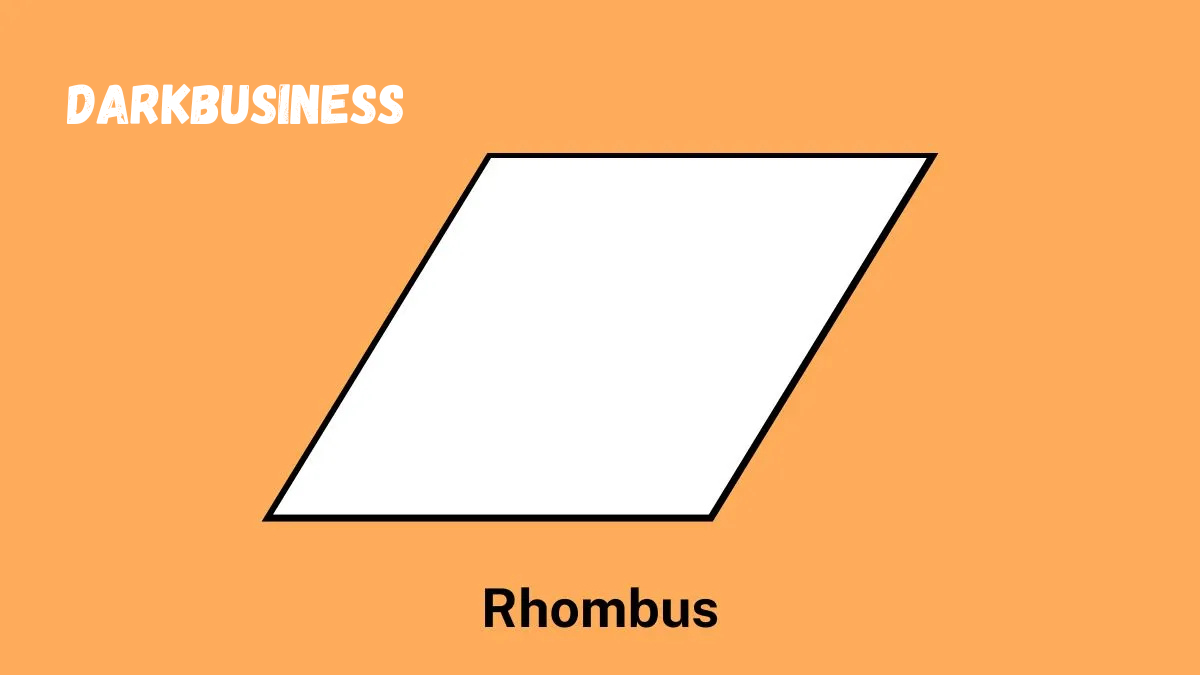
The rhombus shape is a fascinating geometric figure that often appears in both mathematics and real-world designs. Defined as a quadrilateral with all four sides of equal length, the rhombus is sometimes referred to as a diamond shape in everyday contexts. Its unique properties, including equal sides, opposite angles, and perpendicular diagonals, make it an essential concept in geometry. The study of rhombuses not only strengthens spatial reasoning skills but also lays the groundwork for understanding more complex geometric figures like parallelograms, squares, and kites.
Historically, the rhombus has been used in art and architecture for centuries. Ancient mosaics and tile designs frequently employed the rhombus pattern for both aesthetic and structural purposes. In modern times, architects and designers continue to leverage the symmetry and elegance of rhombus shapes in floor plans, building facades, and decorative motifs. Learning about rhombuses allows students and professionals alike to appreciate the interplay between mathematics and design, bridging abstract concepts with tangible applications.
Additionally, understanding the rhombus shape is critical in mathematics education. It serves as a foundational concept in geometry, trigonometry, and even higher-level studies involving vectors and matrices. Through the exploration of a rhombus, students develop critical problem-solving skills, including calculating area, perimeter, and angles. Its versatile applications make it an intriguing shape that extends beyond textbooks and into real-world contexts.
Geometric Properties of the Rhombus Shape
A rhombus is defined by more than just equal sides; it has several unique geometric properties. One of the most notable is that opposite angles of a rhombus are equal, while consecutive angles are supplementary. This means that while the sides remain constant in length, the shape can “lean” in different ways, forming obtuse and acute angles without changing the equality of its sides. These properties distinguish the rhombus from other quadrilaterals and make it a versatile figure in geometry problems.
Diagonals are another defining feature of a rhombus. Unlike many quadrilaterals, the diagonals of a rhombus intersect at right angles, dividing the shape into four congruent right-angled triangles. This perpendicularity is crucial for calculating area and understanding symmetry. Additionally, each diagonal bisects the opposite angles, creating a balanced and symmetrical figure that is visually appealing. The symmetry and uniformity of the rhombus also make it an ideal candidate for tiling and pattern designs.
Comparing the rhombus with other quadrilaterals highlights its unique nature. While squares are special types of rhombuses with all right angles, parallelograms share the property of opposite sides being equal but do not guarantee equal-length sides. Understanding these distinctions is vital for students studying geometry, as it sharpens their analytical skills and helps in solving complex mathematical problems.
Mathematical Formulas Related to the Rhombus Shape
The rhombus offers a variety of formulas that make calculations straightforward once its properties are understood. The most common formula for the area of a rhombus involves its diagonals: Area = ½ × (diagonal 1 × diagonal 2). This formula utilizes the unique property that the diagonals intersect perpendicularly, allowing students to quickly calculate the area without needing the height.
Another formula for area is Area = base × height, which is useful when the perpendicular height from one side to the opposite is known. This formula reinforces the connection between the rhombus and parallelogram, emphasizing that both shapes share fundamental geometric properties. The perimeter of a rhombus is simpler, calculated as Perimeter = 4 × side length, highlighting the equality of all four sides.
In addition to basic formulas, rhombus properties can be used to solve more advanced problems. The relationship between diagonals and angles allows for the determination of unknown sides or angles using trigonometric principles. For example, if the diagonals and one angle are known, the other angles can be easily calculated. Mastering these formulas equips students to tackle both academic and real-world problems where the rhombus shape appears.
Types and Variations of the Rhombus Shape
While all rhombus shape share core properties, there are variations worth noting. A square is a special type of rhombus where all angles are right angles, making it both a rhombus and a square simultaneously. Conversely, a diamond shape, often used in design and daily language, is generally a tilted rhombus but still maintains the equal side lengths and perpendicular diagonals.
Other variations include rhombuses that are not aligned with the axes, sometimes called tilted rhombuses. These can appear in geometric proofs, tiling patterns, and architectural designs. Irregular quadrilaterals, on the other hand, may resemble rhombuses but do not maintain equal sides or diagonal properties. Understanding these distinctions is critical for accurately identifying and applying rhombus properties in mathematics and design.
Rhombus Shape in Comparison with Other Quadrilaterals
Comparing a rhombus with other quadrilaterals helps clarify its unique properties. While squares have both equal sides and right angles, rhombuses only require equal sides, allowing for a wider range of angles. Compared with parallelograms, rhombuses guarantee perpendicular diagonals, whereas parallelogram diagonals may or may not intersect at right angles. Kites also share perpendicular diagonals, but only two adjacent sides are equal, differentiating them from the rhombus.
A visual comparison, often presented in tabular form, helps students and designers quickly understand the differences. These comparisons highlight why the rhombus is both unique and versatile, applicable in theoretical mathematics and practical design contexts.
Real-Life Examples and Applications of the Rhombus Shape
The rhombus is more than a classroom concept; it appears frequently in the real world. In architecture, rhombus shapes are used in window designs, floor tiles, and facades, providing symmetry and visual interest. Road signs, such as diamond-shaped warning signs, rely on the rhombus for easy recognition and uniformity.
Artists and designers often employ rhombus patterns in textiles, graphic designs, and logos to create visually appealing motifs. Even in nature, the rhombus shape appears in crystals, leaves, and other natural formations, demonstrating its inherent structural efficiency. Recognizing these applications helps learners connect abstract geometry to tangible, everyday experiences.
How to Identify and Draw a Rhombus Shape
Identifying a rhombus involves checking for four equal sides and perpendicular diagonals. To draw one, start with two intersecting lines at right angles for the diagonals, then connect the endpoints to form the sides. Using a ruler and compass ensures accuracy, while practice helps students internalize the properties of this unique quadrilateral. Common mistakes, such as assuming all rhombuses are squares, should be avoided to build a strong geometric foundation.
Educational Importance of the Rhombus Shape
The rhombus plays a significant role in education, forming a cornerstone in geometry lessons. It aids in understanding properties of quadrilaterals, symmetry, and angles. Exam problems frequently feature rhombus calculations, reinforcing both formula application and conceptual understanding. Beyond primary education, knowledge of rhombuses supports higher-level math, including coordinate geometry, vector calculations, and structural engineering basics.
Common Misconceptions About the Rhombus Shape
Students often confuse rhombuses with diamonds or squares, assuming that all rhombuses have right angles. Others misunderstand the role of diagonals or think that unequal sides are possible. Addressing these misconceptions is crucial for mastering geometry, ensuring that learners can correctly identify and apply rhombus properties in various contexts.
Conclusion
The rhombus shape is a versatile and essential figure in geometry, offering a rich blend of mathematical properties, practical applications, and visual appeal. From its equal sides and perpendicular diagonals to its real-life presence in design, architecture, and nature, the rhombus provides both educational value and aesthetic inspiration. Understanding its formulas, properties, and variations equips students, designers, and professionals with skills to solve problems and appreciate the geometry around them.
Frequently Asked Questions
What is a rhombus shape?
A rhombus is a quadrilateral with all four sides of equal length.
What are the properties of a rhombus?
All sides are equal, opposite angles are equal, and diagonals bisect each other at right angles.
How is a rhombus different from a square?
A square is a rhombus with all angles equal to 90°.
What is the formula for the area of a rhombus?
Area = (diagonal₁ × diagonal₂) ÷ 2.
Can a rhombus have right angles?
Yes, if all angles are 90°, it becomes a square.
Do the diagonals of a rhombus bisect the angles?
Yes, the diagonals bisect the interior angles.
Is every rhombus a parallelogram?
Yes, because opposite sides are parallel.
How do you calculate the perimeter of a rhombus?
Perimeter = 4 × side length.
Can a rhombus be a rectangle?
Only if all angles are 90°, then it is both a rectangle and a square.
Where is a rhombus used in real life?
In kites, road signs, tiles, and patterns in art and design.
Also Read: gina coladangelo